Test your lawn soil in January or February, at least 3 months after the last feed and before the first spring feed in April. A cheap home kit tells you the pH in a few minutes, and a squeeze of soil in your hand tells you the soil type.
Grass grows well between pH 5.5 and 7. Many lawns already sit in that range, so a test usually tells you to carry on as you are, which is worth knowing before you spend money fixing the wrong thing.
Test once every 3 to 5 years, or straight away if the lawn keeps struggling for no obvious reason.
Why test your soil
The pH is a measure of how acidic or alkaline the soil is. It runs from 1 (very acidic) to 14 (very alkaline), and 7 is neutral.
The pH matters because it decides how easily the grass can take up the feed you give it. It also explains a few problems that keep coming back:
- Thatch building up fast: acidic soils (pH 5.5 or lower) can't support the micro-organisms that break lawn thatch down
- Take-all patch: this disease mostly affects soils of pH 7 or higher, so take-all patch is a sign the soil may be alkaline
- Lots of worm casts: worms prefer soil that isn't acidic, which is why iron sulphate helps with worm casts
Soil type matters just as much. Clay holds water and compacts, sandy soil drains fast and dries out, and loam sits in between. It tells you how often to aerate, what to top dress with and how the lawn will cope with a wet winter or a dry summer.
When to test
The best time is January or February, on a day when the ground isn't frozen or waterlogged.
The AHDB guide to soil sampling says not to sample within 12 weeks of a fertiliser or manure, or within 6 months of lime. A winter test sits well clear of an autumn feed in September and still gives you time to act before the spring feed in April.
If you're making a new lawn, test in August while you prepare the ground. Bare soil that hasn't been fed can be tested any time it isn't frozen.
What pH your lawn needs
Grass likes a pH between 5.5 and 7, but different grasses lean different ways:
- Fine lawns (bents and fescues): slightly acidic, around 5.5 to 6.5
- Family and utility lawns (ryegrass and meadow grasses): close to neutral, around 6.5
- Below 5.5: too acidic; expect thatch, moss and weak growth
- Above 7: too alkaline; the grass struggles to take up iron and other nutrients, and take-all patch is more likely
If you're not sure which grasses you have, my guide to types of grass seed shows how to tell them apart.
How to test the soil pH
A home kit does the job for a lawn. The kind that mixes soil with a powder and water and gives you a colour to match against a chart is more reliable than a cheap probe meter, which can give a different reading each time you push it in.
Follow the instructions on your kit, but the sampling is the same for all of them:
- Walk a W across the lawn and stop at 10 to 15 spots along it. Skip any areas that look different (a mossy corner, a patch that always browns first) and test those separately.
- Lift a small plug of turf at each spot with a trowel or bulb planter.
- Take soil from the top 7.5cm under the turf, the depth AHDB uses for established grassland. That's the root zone the grass feeds from.
- Mix the samples in a clean bucket and pick out stones, roots and bits of thatch.
- Test a spoonful of the mix as the kit says. Use distilled water if it asks for it, as tap water can change the reading.
- Put the turf plugs back and firm them in with your heel.
If one area of the lawn behaves very differently, test it on its own as well.
For a fuller picture, a soil laboratory will test a posted sample for nutrients (phosphate, potash and magnesium) as well as pH, for a modest fee.
How to tell your soil type
You don't need a kit for this. Take a handful of moist soil from 10cm down, squeeze it and roll it between your palms:
- Sandy: feels gritty, won't hold its shape and falls apart when you open your hand
- Loam: feels soft and slightly gritty, holds together loosely and crumbles when you press it
- Clay: feels smooth and sticky, holds its shape and rolls into a sausage you can bend into a ring
What to do with the results
pH between 5.5 and 7
Nothing. Keep up your normal feeding, aerating and top dressing, and test again in 3 to 5 years.
pH below 5.5 (too acidic)
Acidic lawns are often mossy and thatchy. Before you reach for lime, check that the lawn isn't simply too wet, too shaded or too compacted, as these cause most moss problems.
If it really is too acidic, garden lime (ground limestone) raises the pH. Apply it in winter at the rate on the pack, and don't aim higher than about 6.5. Lime spread on an established lawn works slowly from the surface, so test again the following winter before adding more.
Don't lime a fine lawn of bents and fescues unless the pH is well below 5.5. These grasses prefer slightly acidic soil, and liming encourages coarser grasses, weeds and worms.
pH above 7 (too alkaline)
Alkaline soil is common over chalk and limestone, and you can't change it for good. You can nudge the top few centimetres down over time:
- Use lawn sand or iron sulphate as part of your moss control: both make the soil a little more acidic over time (see my lawn sand guide)
- Top dress with a lime-free, sandy loam rather than a chalky topsoil
- Choose a lawn feed without lime in it
Clay soil
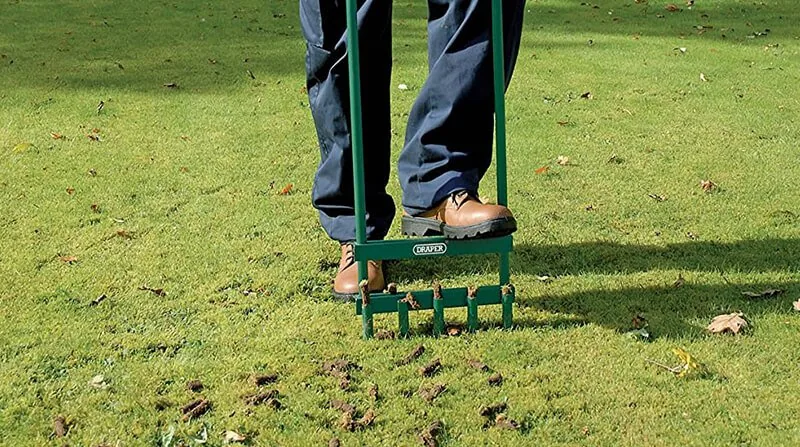
Clay compacts and holds water, so it needs aerating every autumn and a sandy top dressing worked into the holes. If puddles sit on it for hours after rain, read my guide to a waterlogged lawn.
Sandy soil
Sandy soil drains fast and loses feed quickly. A top dressing with some organic matter in it helps it hold water, and little-and-often feeding works better than one big dose.
Common mistakes
These are the mistakes that give a misleading result or a wasted treatment:
- Testing soon after a feed or lime: wait 12 weeks after a feed and 6 months after lime, or the reading reflects the product, not the soil
- Testing one spot: mix samples from across the lawn
- Sampling the turf, not the soil: the thatch layer reads differently from the root zone below it
- Liming because moss is there: fix shade, drainage and compaction first; moss is usually a sign of those, not of pH
- Re-testing too soon: pH changes slowly, so give it a year
FAQs
What is the best pH for a lawn?
Between 5.5 and 7. A family lawn with ryegrass does best close to 6.5, and a fine lawn of bents and fescues prefers it slightly more acidic, around 5.5 to 6.5.
Are home soil test kits accurate?
They're accurate enough for a lawn, as long as you mix samples from several spots and follow the instructions. Colour-chart kits are more reliable than cheap probe meters. If you need nutrient levels as well as pH, use a laboratory service.
How often should I test my lawn soil?
Every 3 to 5 years is plenty for most lawns, the same cycle farmers use for grassland. Test sooner if you've changed the way you treat the lawn, if a problem keeps coming back, or before you sow or lay a new lawn.
Does moss mean my soil is acidic?
Not always. Moss grows wherever grass is weak, and shade, poor drainage, compaction and mowing too short are more common causes than pH. A soil test tells you whether pH is part of the problem.
Read next: Aerating your lawn, the main fix for compacted and badly drained soil.